

breaking news: great fantasy isn't dead
a spoiler-free review of The Mistborn Saga by Brandon Sanderson

this right here, is the reason i read. but consuming this delicious story was not simply an act of reading—it would more accurately be described as feasting. this saga is a banquet of rare delicacies baked and presented perfectly for its reader’s enjoyment. no end left loose, no angle unexplored, no character inconsequential, no reader unchanged.
“A man is what he has passion about. I’ve found that if you give up what you want most for what you think you should want more, you’ll just end up miserable.”
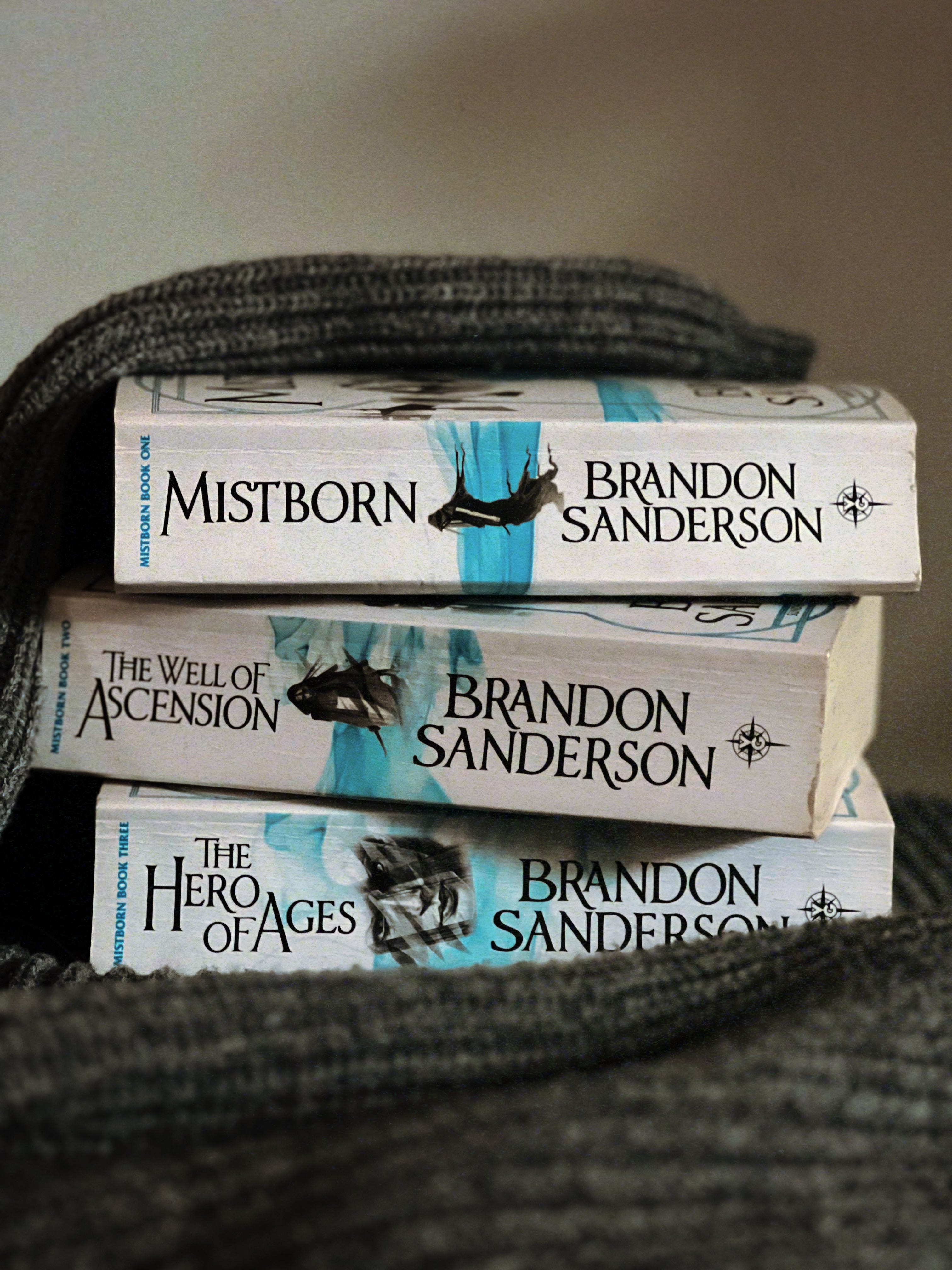
the trilogy by Brandon Sanderson kicks off with Mistborn: The Final Empire—a fish-hook so enticing i didn’t even stop to consider what i was getting reeled into. the world grips immediately. a mysterious night-time mist that is said to steal men's souls. a city plagued by constant ashfall, where flowers and greenery are things of mere legend. creatures who can wear any face they consume linger in the darkness and an immortal lord-ruler who is equal parts revered and feared looms above it all. The Well of Ascension is an unmatched follow-up to its predecessor, unwinding a series of plot twists and character developments that expanded the story’s moral, political, and personal implications for the tearful finale, The Hero of Ages.
abridged version: should you read it?
✅ RECOMMEND if: you enjoy large scale epic fantasies, scientific-based magic systems, political/economical intrigue, a strong female protagonist, the found family trope, & a rebellion/uprising story
🚫 RECOMMEND if: you don’t enjoy strict & logical magic systems, committing to long-term plot payoffs, long-winded narration with political, moral, and ethical discussions, or a straight-forward writing style
unabridged version: my thoughts
i fear i could speak for hours about the beauty, the imagination, and the impact of these three books. but hours i do not have, and neither do you. so i’ll go as “unabridged” as can be deemed reasonable.
“Somehow, we'll find it. The balance between whom we wish to be and whom we need to be. But for now, we simply have to be satisfied with who we are.”
to keep myself from rambling, i want to focus on the 3 things that, in my mind, separate a great story from a good story. because this series had all of them.
— 1 — high stakes that prompt thought-provoking themes
stories that don’t contain impactful themes that apply to our real lives can still be good, but they aren’t going to be the stories that leave a mark, that change lives. impactful stories both immerse the reader in the fantastical world and provoke critical thought about real-life human morality, belief, and behavior.
a central part of the story is the political and social structure of The Final Empire (the world in which the trilogy takes place). rebellion between the skaa and their brutal noble oppressors is already brewing at the beginning of Mistborn: The Final Empire, and the class divide holds great residual value even after the system is overthrown and the skaa are freed. the nuance of political reform is expertly showcased in Elend’s frustration to rebuild a world that often seems to prefer the familiarity of oppression rather than the unknown territory of liberation.
the complexity of religion and faith is also explored in a truly beautiful way, and i say this as someone who is atheist and ultimately uninterested in the study of religion in general. this theme is explored mostly through Sazed’s character (who i will discuss in more detail later) and the crisis of faith he undergoes as a result of grief and loss. it simultaneously ties deeply into the story as well as transcends it, prompting the reader to consider real-life philosophies of faith and the purposes it can serve.
— 2 — complex & nuanced world-building
writing fantasy might seem easy—if everything is made up, then the world, magic system, and characters can operate however they want to, right? wrong. reality as we know it may not apply, but that just means the author needs to build an entirely new reality. when done well, the reader enjoys and accepts the new world. when done masterfully, the reader lives in and operates by the rules of the new world as if it is their reality.
what exactly do i mean by that? i’ll start by using magic-systems, an essential part of fantasy world-building, as an example. magic without bounds is boring—i’ve no interest in reading about a witch who can perform any spell as long as she just learns the correct string of latin phrases. as a reader, immersion in a magic-system like that is impossible because there are no limits for which reality to operate by. at the risk of sounding … well, obvious—it feels like a fantasy. it can still be a good story, but a great story convinces me that i’m not in a fantasy anymore, i’m in a new reality.
in The Final Empire, certain individuals are able to use Allomancy and gain supernatural powers of speed, strength, heightened senses, or emotional manipulation. this is done by swallowing specific liquid metals and “burning” them internally to activate the desired power. there are Mistings, people who can only burn one type of metal and use its corresponding power, and the much rarer Mistborns, people who can burn all the metals and use all of their corresponding powers. the concept is simple, but the rules and limits of this magic are logical, well-defined, and most importantly, they remain consistent throughout the entire trilogy. the reader learns more about the system along with the characters, but the rules are never overstepped or blurred to act as plot armor or a convenient deus ex machina, which is a common problem in stories with vague magic systems. when Vin “burns” iron, i know that she’ll be able to pull a man’s metal sword from his hand, and when she “burns” steel, i know that she’ll then be able to push that blade back into his own stomach. and i know this because those are the indisputable rules of Allomancy—rules of The Final Empire’s reality.
as i discussed above, the political and social structure not only creates that avenue for impactful themes, it’s also another element that brings the world-building from good to great. it’s all warm and fuzzy when everyone gets along or when there’s a clear “good guy” and a “big bad”—but stories that lack nuance are forgettable. the way the skaa react to being liberated in this story was 100% based in reality, even if the entire world that Sanderson built wasn’t. some deified their savior as a martyr and started an entire religion based on his ideologies. some villainized and cursed him for killing their god, despite no longer being under that god’s boot. some prayed for another god to take their oppressor’s place, so they might be returned to a life they understood and were familiar with. some were unsatisfied with their liberation and chased revenge, becoming the enemies they had suffered so greatly under. the many moving parts in the empire’s politics and economics facilitate these kind of genuine human reactions, because even actions taken with the best of intentions can have an unpredictable butterfly effect. such complexities wouldn’t be possible without well developed world-building.
— 3 — emotional impact through character depth
an author could write the most interesting and unique plot ever with twists i didn’t see coming and an ending that rocked my socks off, but guess what? i wouldn’t give a rat’s ass about it if the characters were akin to bumps on a log. good characters have strengths, flaws, and personalities that align with their dialogue and actions. great characters have all of those things plus a growth journey that ties into the plot and impacts it in a way that brings new meaning to events.
if i met Kelsier in real life, i’d recognize him. that’s how distinct and developed his personality is in my brain. he embodies what i look for in a well-done character because his personality isn’t black and white, and we never truly get clarity on the grey parts. i love the way his altruism occasionally peels away at the edges, revealing possible personal motivations that both the reader and the characters struggle to puzzle out. and as frustrating as it is, i love that those motivations never step into the light. he became more than a character in a book—he was a man i wanted to talk to, to understand, to know.
“This is not an easy time in which to live. That does not mean it has to be a difficult time to love." - Sazed
i mentioned the importance of Sazed’s character earlier, but to truly explain his impact would literally require a read of the trilogy. i rarely find myself believing that all 2,000+ pages of a series are necessary, but this one is a rare exception. this man’s emotional journey carries a weight unlike any other character i’ve ever encountered. how does a man who has dedicated his life to the safekeeping of long-forgotten faiths—of beliefs that were snuffed out by persecution and oppression—how does a man like that hold onto faith when his home burns, when his loved ones perish, when no hand from the sky offers aid or mercy at the end of the world? Sanderson explores this concept with Sazed, and it’s both devastating and inspiring to witness.
Vin, the main character, is independent, strong, and self-assured pretty much from the get go, but the doubts and failings she suffers occasionally make her pleasantly flawed. she wants to be needed, but she doesn’t want to feel used. she wants to be loved, but struggles to believe she’s worthy of it. these are raw and relatable feelings that bring the reader into Vin’s head when she’s making decisions, and it gives those decisions an emotional impact that wouldn’t exist without her internal complexity.
“My behavior is nonetheless, deplorable. Unfortunately, I'm quite prone to such bouts of deplorability—take for instance, my fondness for reading books at the dinner table.” — Elend Venture
Elend is a beautifully done example of character subversion. he’s introduced as a flippant, unserious nobleman who seemingly takes his own privilege for granted. i felt for sure his role would be minimal to the story at best, but Sanderson completely turned Elend’s first impression on the head and slowly revealed an intensely sincere, principled, and loving man who never once compromised his values, even in the face of the world’s demise. in every book, i feared for his fate because i knew how uncompromising in his morals he remained—and i was sure his desire to do the right thing would be the end of him. being terrified of a character’s death at every turn of the page? my anxiety was off the charts, but i doubt there’s a better indicator of a well-written character.
even the minor characters are unforgettable. Spook, Clubs, Ham, Dox, and Breeze aren’t just background flavor or comedic relief. their characters are often used to bring philosophical balance to the group, challenge and foster each other’s character arcs, and ultimately show the reader the cost of rebellion. they each teach their own lessons about humanity, even if their character is rather reluctant about it.
while i must refrain from discussing exactly who the villains of this trilogy are (to avoid spoilers), i can tell you that they operate in grey areas of morality, one of my favorite things to see in a good villain. one of the best parts of this series was watching the heroes realize that their cause may not have been as black and white as they thought it was. after overthrowing their ruler, they have to grapple with the same dilemmas that their oppressor did—if it means saving the world, is deception and violence justified? must idealism be sacrificed for practicality? if all you have to fight with is hope, is that enough?
“I am the one thing you can never kill. I am Hope.”
my rating breakdown
i rate books on a 5 star scale—i’m a big fan of the app Fable and this is the scale they use. if you hate this, you can just refer to my abridged recommendation above. but if you want a more specific breakdown, i’ll provide that here.
TOTAL = 5/5⭐️
no surprise, i have nothing bad at all to say about this series. it’s by far the best fantasy series i’ve ever read—so take all 5 of my stars and keep them!
if you’ve read this series, let me know your thoughts in the comments! and don’t forget to subscribe so you don’t miss any future book reviews <3